
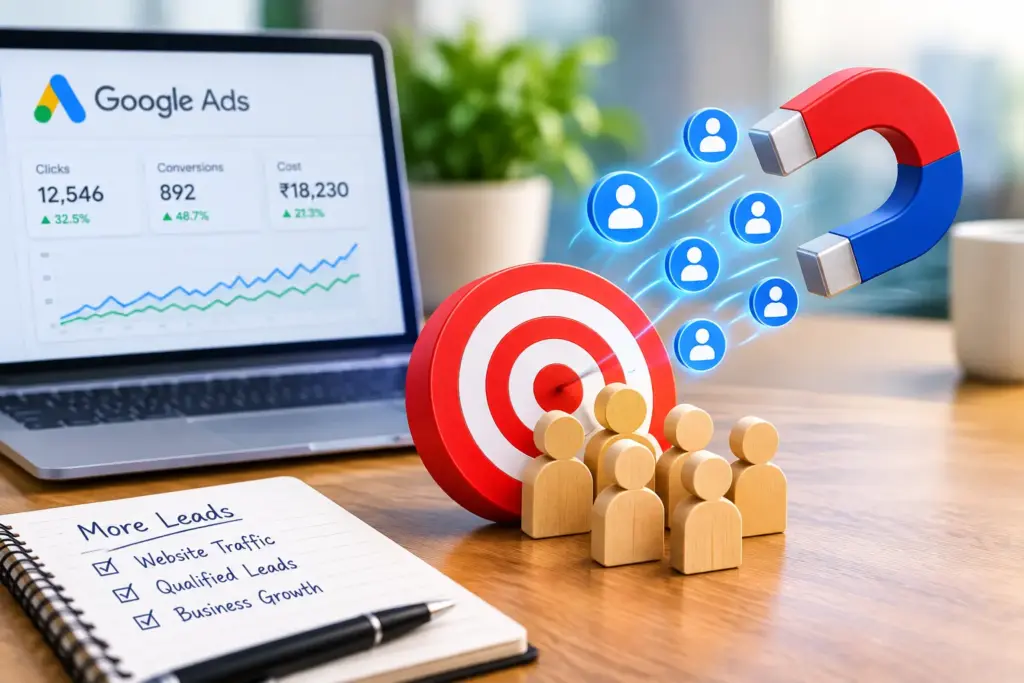
In 2026, businesses are looking for better ways to reach customers, generate leads, and make every advertising rupee count. Google Ads continues to be an important part of digital marketing, helping businesses connect with people who are actively searching for products and services.
But successful advertising is no longer just about launching a campaign and waiting for clicks. Businesses need smarter targeting, relevant messaging, accurate measurement, and continuous optimization.
So, what makes Google Ads more important in 2026, and how can businesses use it to achieve better results?
What Is Google Ads?
Google Ads is an online advertising platform that allows businesses to promote their products and services across Google’s advertising network.
One of its most valuable features is the ability to reach customers based on what they search for. For example, someone searching for “Google Ads specialist in Malappuram” may already be looking for a professional service.
Google Ads can help businesses appear in front of relevant audiences through formats such as:
Google Search Ads
Shopping Ads
Display Ads
Video Ads
Performance Max campaigns
The right campaign type depends on the business’s goals, audience, and advertising strategy.
Why Google Ads Matters for Businesses in 2026
1. Reach Customers with Strong Purchase Intent
One of the biggest advantages of Google Search Ads is that they can reach people when they are actively searching for a solution.
For example, a person searching for:
“SEO services for small business”
“Google Ads agency near me”
“best digital marketer in Malappuram”
may already have a specific need.
By targeting relevant search terms, businesses can connect with potential customers at an important stage of their buying journey.
2. Smarter Automation Can Improve Campaign Management
Google Ads has increasingly introduced automation and AI-powered features to help advertisers manage campaigns, identify opportunities, and optimize performance.
In 2026, Google’s advertising ecosystem is placing greater emphasis on AI-assisted campaign management and automated optimization. These tools can help advertisers work more efficiently, but they still require clear goals, accurate data, and human oversight. <Cite refs={[“turn0search17″,”turn0search21”]} />
Automation is most useful when it supports a well-planned strategy rather than replacing strategic decision-making.
3. Better Targeting Helps Reduce Wasted Budget
A successful Google Ads campaign is not about reaching everyone. It is about reaching the right audience.
Businesses can improve targeting by considering:
Relevant keywords
Search intent
Location
Audience signals
Device usage
Time of day
Customer needs
For a local business, targeting customers in a specific service area can help make the campaign more relevant and prevent unnecessary spending outside the intended market.
4. Conversion Tracking Makes Results Measurable
One of the strongest benefits of Google Ads is the ability to measure actions that matter to a business.
Depending on the campaign, conversions may include:
Website form submissions
Phone calls
WhatsApp enquiries
Product purchases
Appointment bookings
Sign-ups
Conversion tracking helps businesses understand which campaigns, keywords, and ads are contributing to their goals.
Without proper tracking, it becomes difficult to know whether advertising is generating real business value.
5. AI Is Changing How Businesses Approach Advertising
AI is changing how marketers create campaigns, analyze performance, and identify opportunities.
Google’s 2026 advertising updates highlight the growing role of Gemini-powered capabilities across its advertising products. These developments are designed to help businesses improve campaign creation, reach, and optimization. <Cite refs={[“turn0search2″,”turn0search15”]} />
However, AI does not remove the need for a clear marketing strategy. Businesses still need to understand their customers, define their goals, and evaluate whether campaigns are producing meaningful results.
6. Google Ads Can Support Faster Lead Generation
SEO is valuable for building long-term organic visibility, but Google Ads can help businesses reach potential customers more quickly through paid search placements.
For example, a service business can create a campaign targeting people searching for its services in a specific location.
When combined with a relevant landing page and a clear call to action, Google Ads can support lead generation through:
Contact forms
Phone calls
WhatsApp messages
Consultation bookings
The quality of the landing page and the relevance of the offer are just as important as the advertising campaign itself.
7. Better Landing Pages Improve Advertising Performance
Getting a click is only the beginning.
If a visitor arrives on a confusing, slow, or irrelevant landing page, they may leave without taking action.
A strong Google Ads landing page should include:
A clear headline
Relevant information
A strong value proposition
Easy navigation
Mobile-friendly design
A visible call to action
Simple enquiry or booking options
Your ad and landing page should match the customer’s search intent. When the message is consistent, visitors can understand the offer more easily.
8. Local Businesses Can Compete More Effectively
Google Ads can be especially useful for small and local businesses that want to reach customers in a specific area.
For example, a business in Malappuram can create campaigns targeting relevant local searches and service-related keywords.
Instead of relying only on broad advertising, businesses can focus on:
Location-specific campaigns
Local search intent
Relevant service keywords
Call and enquiry conversions
Landing pages tailored to the local audience
This can help businesses compete for attention when potential customers are actively searching.
Google Ads vs. SEO: Which Should Businesses Choose?
Google Ads and SEO serve different purposes.
Google Ads helps businesses reach targeted audiences through paid advertising and can support immediate campaign goals.
SEO focuses on improving organic search visibility and building long-term online presence.
For many businesses, using both can be a strong approach:
Google Ads can help generate traffic and leads.
SEO can build long-term organic visibility.
Both can provide insights into customer search behavior.
Together, they can support a more complete digital marketing strategy.
The right balance depends on the business’s goals, competition, budget, and customer journey.
How to Get Better Results from Google Ads in 2026
If you want to improve your Google Ads performance, focus on these fundamentals:
1. Set Clear Campaign Goals
Decide whether your main goal is leads, sales, calls, website traffic, or brand awareness.
2. Research Relevant Keywords
Choose keywords that match what your potential customers are actually searching for.
3. Write Relevant Ad Copy
Create headlines and descriptions that clearly communicate your offer and encourage users to take action.
4. Use Accurate Conversion Tracking
Track meaningful actions such as enquiries, calls, purchases, or bookings.
5. Optimize Your Landing Pages
Make sure the landing page matches the ad and makes it easy for visitors to convert.
6. Monitor Campaign Performance
Review important metrics such as clicks, conversions, cost per conversion, and return on ad spend where applicable.
7. Use Automation Carefully
Automation can help with campaign management, but businesses should still monitor performance and make strategic decisions based on their goals.
8. Keep Improving
Google Ads is not a “set it and forget it” strategy. Regular testing and optimization can help identify what works and where improvements are needed.
Final Thoughts
Google Ads in 2026 is becoming smarter, more automated, and increasingly focused on helping businesses connect with the right customers.
But better technology alone does not guarantee better results. Successful advertising still depends on understanding your audience, choosing the right keywords, creating relevant ads, tracking conversions, and continuously improving campaigns.
For businesses that want to generate quality leads and grow online, Google Ads can be a powerful part of a well-planned digital marketing strategy.
Looking to improve your Google Ads performance? A focused campaign strategy can help your business reach the right audience and make your advertising budget work more effectively.